 Inditech
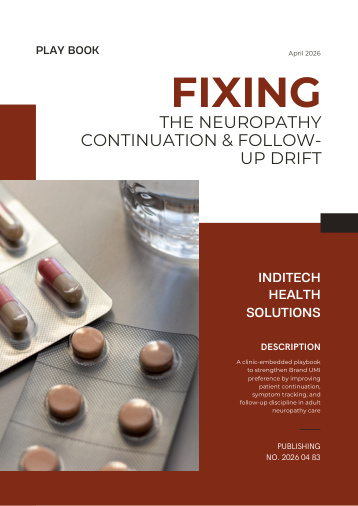
Read from start to finish, or use the contents to jump to what you need. You can also use your browser’s Find command to search the full text.
Table of contents
Explore
03–04 EXECUTIVE SUMMARY
05 MARKET REALITY
06-07 PROBLEM FRAMEWORK
08-09 THE BEHAVIOURAL
MOMENT MAP
10-11 THE CLINIC-CENTRED
SOLUTION FRAMEWORK
12-13 REPLICATION BLUEPRINT
14 BRAND OUTCOME
EXPLORE
Back to contentsExecutive Summary
THE DRIFT DEFINITION
Brand UMI operates in a category where clinical familiarity is well established, and neuropathy management is routinely addressed within adult practice. On the surface, this should support consistent and repeatable brand usage.
However, Brand UMI functions within a treatment window where outcomes are gradual, subjective, and dependent on sustained patient continuation.
From the brand’s standpoint, the loss of control begins after prescription. Symptom relief is not immediate, expectations remain loosely defined, and continuation is rarely structured. Patients discontinue early, follow-up becomes inconsistent, and symptom progression is seldom tracked with clarity. For Brand UMI, the gap is not in therapy selection, but in the absence of sustained treatment continuity.
EXECUTIVE SUMMARY
“THIS MANIFESTS PREDICTABLY: CONTINUATION WEAKENS,
PERCEIVED
EFFECTIVENESS DECLINES, REPEAT PRESCRIPTIONS LOSE STABILITY, AND SUBSTITUTION RISK INCREASES.”
In a category defined by compositional similarity, differentiation at initiation remains limited. Brand performance is therefore determined less by choice and more by continuation control. The commercial challenge is precise: not awareness, but the ability to sustain therapy, anchor expectations, and remain present across the treatment window.
How can Brand UMI ensure that therapy is continued long enough to deliver visible benefit, while enabling physicians to retain structured control over neuropathy care?
This is not a molecule constraint. It is a continuity and behaviour design problem, where outcomes are shaped by how the journey is held, not how the therapy is introduced.
EXECUTIVE SUMMARY
Back to contentsMarket Reality
THE GUIDELINE–REALITY GAP
For Brand UMI, neuropathy management is not limited by clinical clarity, but by how consistently that clarity translates into practice beyond the point of care. The intended pathway is structured -therapy is designed to be sustained, reviewed periodically, and adjusted based on symptom evolution. Yet in execution, this pathway becomes fragmented once the patient leaves the clinic.
In real-world adult practice:
patients expect rapid relief and disengage early doctors have limited visibility between visits follow-up timelines are loosely followed symptom changes are not tracked systematically clinic conversations are repeated instead of reinforced
“FOR BRAND UMI, THIS CREATES A FUNCTIONAL DISCONNECT BETWEEN PLANNED TREATMENT PATHWAYS AND REAL-WORLD THERAPY BEHAVIOUR.”
The consequence is not immediate discontinuation, but progressive dilution - where treatment lacks reinforcement, and clinical intent is not consistently carried forward. The opportunity lies in stabilising this in-between phase - by enabling a more structured, visible, and continuous treatment experience between consultations.
MARKET REALITY
Back to contentsProblem Framework
THE BRAND PAIN
BRAND UMI’S GROWTH IS SHAPED BY THREE REINFORCING BEHAVIOURAL
GAPS THAT
COLLECTIVELY WEAKEN TREATMENT CONTINUITY.
STRENGTHEN
continuation by anchoring patient expectations
In the absence of defined timelines for improvement, patients interpret delayed relief as lack of efficacy and discontinue prematurely. This compresses treatment cycles and limits the likelihood of repeat prescribing.
STABILISE
continuity by structuring follow-up behaviour
Return visits are rarely aligned to therapeutic need - patients either delay beyond the optimal window or re-present only upon symptom escalation. This disrupts continuity and reduces clinical control over the treatment course.
PROBLEM FRAMEWORK
REINFORCE
confidence by enabling structured symptom tracking
Neuropathy progression remains largely subjective, with limited structured documentation between consultations. This constrains the physician’s ability to assess response, reinforce continuation, and guide therapy with precision.
STRATEGIC IMPLICATION
FOR BRAND UMI, GROWTH IS SHAPED BEYOND INITIATION. IT IS STRENGTHENED
WHEN
CONTINUATION IS SUPPORTED, PROGRESS IS MADE VISIBLE, AND FOLLOW-UP IS HELD WITH INTENT.
BRANDS THAT
STRUCTURE THIS PATHWAY MOVE TOWARD REPEAT USAGE AND
DEEPER CLINICAL
ASSOCIATION OVER TIME.
PROBLEM FRAMEWORK
Back to contentsThe Behavioural Moment Map
FOR BRAND UMI
Neuropathy care progresses across three defining moments, each shaping how the treatment journey is experienced and sustained.
Moment 1: Initiation and therapeutic alignment
Patients present with tingling, numbness, or burning sensations, prompting therapy initiation. At this stage, Brand UMI enters the treatment pathway, with expectations introduced and the therapeutic direction established.
< NEUROPATHY CARE PROGRESSES ACROSS THREE DEFINING MOMENTS, EACH SHAPING HOW THE TREATMENT JOURNEY IS EXPERIENCED AND SUSTAINED.
THE BEHAVIOURAL MOMENT MAP
Moment 2: At-home continuation and perception formation (decisive)
Patients independently navigate therapy beyond the clinic setting. This phase shapes adherence, influences perceived benefit, and determines whether continuation is sustained with intent.
Moment 3: Follow-up and clinical reinforcement
Patients return for reassessment or gradually disengage. The quality and direction of this interaction are determined by how the treatment experience has unfolded between visits.
IMPLICATION
FOR BRAND UMI, PERFORMANCE IS SHAPED MOST CRITICALLY DURING THE CONTINUATION PHASE. WHEN THIS INTERVAL
IS SUPPORTED AND
STRUCTURED, THERAPY SUSTAINS LONG ENOUGH FOR VALUE TO BE REALISED - ENABLING CONTINUITY, CONFIDENCE,
AND REPEAT
PRESCRIBING TO FOLLOW.
THE BEHAVIOURAL MOMENT MAP
Back to contentsThe Clinic-centred Solution Framework
For Brand UMI, the opportunity lies in enabling clinics to bring greater structure and continuity to patient behaviour between visits.
EXPLAIN
(Anchor expectations at initiation)
Brand UMI can support clearer therapeutic alignment by helping patients understand the nature of neuropathy care -where improvement is gradual, timelines are defined, and continuation is essential for outcomes to emerge.
SUPPORT
(Enable continuity and guided tracking)
Through structured check-ins, Brand UMI can help sustain engagement beyond the clinic -supporting consistent therapy use, making gradual changes more perceptible, and allowing relevant signals to surface with intent.
EXPLAIN → SUPPORT → RECALL
RECALL
(Stabilise follow-up discipline)
By reinforcing timely return behaviour, Brand UMI can help ensure that follow-up remains aligned to therapeutic need -strengthening continuity and maintaining clinical oversight across the treatment window.
SOLUTION FRAMEWORK
Back to contentsStrategic Outcome
Brand UMI becomes associated with a more structured and reliable care experience - where patient understanding is clearer, continuation is more consistent, and follow-up is retained with intent. Preference builds through the quality of continuity and experience, rather than differentiation at the point of claim.
SOLUTION FRAMEWORK
Back to contentsReplication Blueprint
IMPLEMENTATION MODULES
Module
Neuropathy Continuation Companion
Timed Check-ins (Day
7 / 21 / 45)
Expectation & Education Layer
Red-Flag & Escalation
Guidance
Follow-Up Workflow
Tool
What the Brand Installs in Clinics
Clinic-branded patient support microsite
Structured adherence and symptom inputs
Simple explanation of timelines and therapy
purpose
Clear “when to return”
triggers
Clinic-driven revisit
reminders
What Problem It
Solves
Patients lack clarity post-prescription
No visibility between
visits
Unrealistic expectations
Delayed clinical review
Missed or delayed
follow-ups
What It Delivers for
Brand UMI
Improves continuation and understanding
Enables early intervention and
retention
Reduces early drop-off
Improves safety perception
Strengthens repeat consultations
REPLICATION BLUEPRINT
Back to contentsBrand Growth Execution Checklist
Patients stay on therapy long enough to experience benefit
Follow-up visits become more structured and predictable
Symptom progression is better understood at review
Repeat prescribing increases within the same patient
Brand UMI becomes associated with continuity-driven neuropathy care
REPLICATION BLUEPRINT
Back to contentsBrand Outcome
MEASUREMENT LOGIC
Scroll sideways to see all columns →
| Measurement Layer | What Is Tracked | Brand Impact |
|---|---|---|
| Clinic Activation | Number of prescribers using the workflow | Integration into routine practice |
| Patient Engagement | Microsite opens and check-in completion | Improved continuation behaviour |
| Continuation Signals | Day 7 / 21 / 45 adherence trends | Longer treatment cycles |
| Follow-Up Compliance | Timely revisit rates | Better patient retention |
| Brand Recall & Preference | Pre/post perception within participating clinics | Strengthened brand positioning |
BRAND OUTCOME
Back to contentsThe Strategic Opportunity & CTA
Brand UMI operates in a category where prescriptions are common, but outcomes depend on sustained patient behaviour. The opportunity lies in improving continuation, expectation alignment, and follow-up discipline, where most variability exists.
Patients often begin therapy correctly but discontinue before benefit is realised. Clinics lack visibility during this period, leading to inconsistent outcomes and reduced repeat prescribing.
By embedding Brand UMI into a clinic-driven neuropathy continuity workflow, the brand can extend its role beyond prescription into the full patient journey.
Over time, Brand UMI can become the brand associated not just with neuropathy treatment - but with patients who continue, return, and improve under structured care.
WEBSITE
AMIT@INDITECH.CO.INEmail (opens in a new tab)
Back to contents